
If your CEO turned to you tomorrow and asked, “what’s our plan for AI search?” — could you answer in one clear sentence?
Most teams can’t. They can tell you their Google rankings to two decimal places. Ask them whether ChatGPT recommends them over their biggest competitor, and how that’s changed in the last month, and the room goes quiet.
That gap is the whole problem. Buyers have already moved. ChatGPT is handling something on the order of 72 billion messages a month1, and Google’s own results increasingly answer the question on the page — zero-click searches hit 68% in early 20262, and when an AI Overview appears it cuts clicks to the top result by more than half3. The decision is increasingly made inside the answer, before anyone visits your site.
So the question stops being “do I rank?” and becomes: when AI talks about my category, does it find me, understand me, cite me, and recommend me?
This post is the map. It’s the framework we use at BrandAxis to turn that vague anxiety into a plan you can actually run — and it’s the spine of this whole series.
What “AI Alignment” actually means
We call the goal AI Alignment: getting AI models aligned with how you want your brand to be perceived — and getting them to surface you more often.
It breaks into two dimensions:
- Presence — do you show up in AI answers at all?
- Perception — when you do show up, is it accurate and favourable?
You can be strong on one and weak on the other. A startup might be perceived perfectly by the three people who know it and have zero presence. A legacy brand might have huge presence and a perception problem — AI confidently repeating a product it sunset two years ago. Alignment is both: present and accurately, favorably perceived.
This is a different game from classic SEO, and it’s worth being honest about why. For twenty years the unit of SEO was the page — crawl it, index it, rank it. In AI answers, the unit shifts from page to mention. The success metric shifts from rank to share of answer. Models think in entities, not keywords, and they cite sources, not backlinks. Your old playbook still matters — but it’s now one input into a bigger system.
The framework: Found → Understood → Cited → Recommended
You don’t reach alignment in one move. You climb four layers, in order. Each one is a prerequisite for the next.
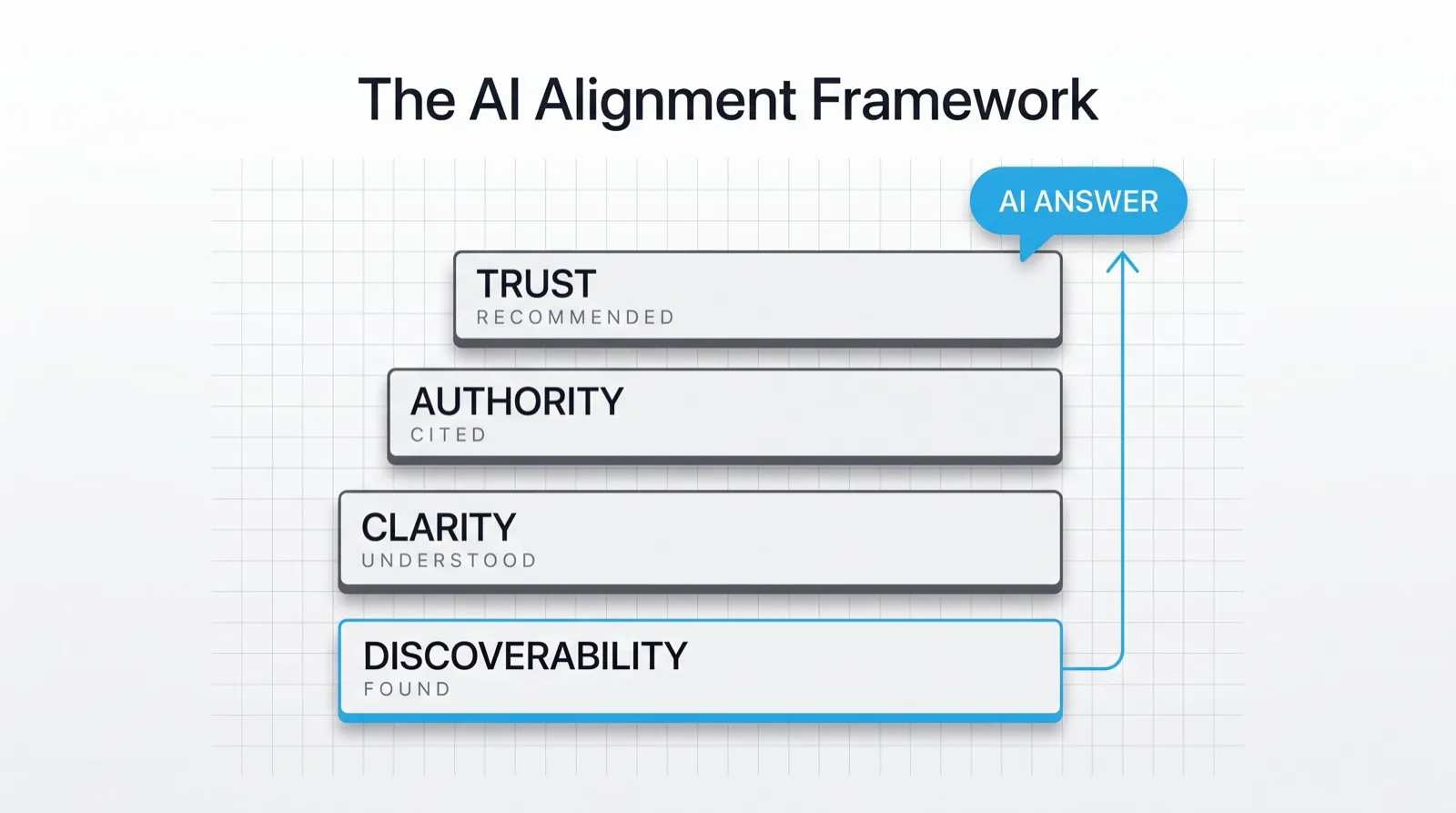
| Layer | The question it answers | In plain words |
|---|---|---|
| 1. Discoverability | Can AI find you? | Found |
| 2. Clarity | Does AI understand you correctly? | Understood |
| 3. Authority | Does AI consider you credible enough to cite? | Cited |
| 4. Trust | Does AI actively recommend you? | Recommended |
The first two layers are table stakes — you have to be found and understood before anything else is possible. The last two are where the competition actually happens: getting cited as a source, and getting recommended over the alternatives.
Here’s how each layer works, and where to go deep on it.
Layer 1 — Discoverability: can AI find you?
Models don’t pull answers from thin air. Modern AI search leans on retrieval — the model fetches relevant content from the live web and its training data, then writes an answer grounded in what it found. If your brand isn’t present in the sources a model reaches for, you simply don’t exist in the answer.
Discoverability is about being in the room: crawlable by AI bots, present in the third-party sources models trust, and described in machine-readable ways. It’s the layer where technical SEO, content distribution, and a file like llms.txt all matter — and where a single misconfiguration, like Cloudflare blocking AI crawlers by default, can quietly erase you.
→ Deep dive: Discoverability: getting your brand into the sources AI reads
Layer 2 — Clarity: does AI understand you correctly?
Being found isn’t enough if the model gets you wrong. Clarity is about the entity — the structured idea of “your brand” that lives in knowledge bases like Google’s Knowledge Graph, Wikipedia, and Wikidata, and that models lean on to understand who you are, what you do, and who you compete with.
When that entity record is thin or wrong, you get the AI version of a bad first impression: the model confuses you with a competitor, cites a discontinued product, or hallucinates facts about you. Clarity work is making your brand unambiguous — consistent facts everywhere, clean structured data, and a tight, correct entity.
→ Deep dive: Clarity: making AI describe your brand accurately
Layer 3 — Authority: does AI cite you?
Once you’re found and understood, the contest begins: of all the brands the model could mention, why you? Authority is earned the way trust is earned anywhere — by lots of credible, independent sources talking about you.
The data backs this up. Ahrefs studied 75,000 brands and found that brand web mentions had the strongest correlation with AI Overview brand visibility (0.664) — well ahead of classic metrics like Domain Rating (0.266) or raw page count (~0.194). It’s not about your website4; it’s about how widely your brand shows up across the web — in Reddit threads, comparison articles, and the places AI loves to cite. This is why AI citations behave so differently from backlinks.
→ Deep dive: Authority: how to become a brand AI cites and recommends
Layer 4 — Trust: does AI recommend you?
Being cited isn’t the same as being recommended. The top layer is sentiment and trust — whether the model speaks about you with confidence, and whether it puts you forward when a buyer asks “what’s the best X.”
Models read the room: reviews on G2, Trustpilot, and Yelp; the tone of discussion about you; whether the story is consistent. If most of what AI can see about you is thin, dated, or negative, it hedges — or recommends someone else. Trust is the layer that turns a mention into a recommendation.
→ Deep dive: Trust: earning AI’s confidence so it recommends you
Why the order matters
The layers compound, and they compound in sequence. There’s no point investing in authority-building digital PR if AI crawlers can’t read your site (Discoverability). There’s no point chasing recommendations if the model still thinks you’re a competitor (Clarity). Most teams skip straight to the fun part — “let’s get mentioned on Reddit!” — and get nowhere, because the foundation isn’t there.
Work bottom-up:
- Get found. Fix crawlability and source presence.
- Get understood. Clean up your entity and your facts.
- Get cited. Earn mentions in the sources models trust.
- Get recommended. Build the sentiment and trust signals that tip a mention into a recommendation.
Where to start
You can’t improve what you can’t see, and measurement is the single biggest gap5 in most teams’ AI strategy today. So the series starts with the two practical bookends:
- First, understand the shift well enough to get buy-in.
- Then run an AI visibility audit to get your baseline across the four layers.
- Finally, turn it into a 90-day AI Alignment plan with KPIs you can report on.
Prefer everything up front? Grab the full toolkit — every worksheet, template, and checklist from this course in one file you can drop into Docs, Sheets, or Notion.
Download the AI Alignment ToolkitRead the layer deep-dives in between, in order. By the end you’ll have a real answer to that CEO question — and a plan behind it.
Sources
-
Search Engine Land — SEO, GEO, or ASO? The new era of brand visibility in AI (research) ↩
-
Search Engine Land — Google zero-click searches reach 68% in early 2026 ↩
-
Ahrefs — AI Overviews reduce clicks (update) ↩
-
Ahrefs — Top brand visibility factors in ChatGPT, AI Mode & AI Overviews (75k brands) ↩
-
Search Engine Land — 8 GEO metrics to track in 2026 ↩